


Sustainability
WHAT IT MEANS
Today, this very popular word and topic appears in various contexts. Some may feel it is overused, commercially exploited, or even that it requires a strict checklist of characteristics to claim a product is sustainable. The truth is that this label is not subject to any mandatory certification, and the list of rules or prerequisites is not limited. When a manufacturer states WHY they label their product as sustainable, they contribute to spreading awareness about the qualities that help us make better choices when shopping, directly influencing the future direction of production. Ultimately, what is produced is what the customer demands, and the key to good, responsible choices is being informed. It is different for labels like "bio" or "organic," where the consumer should know exactly what the designation means; these marks are subject to numerous, strict, and publicly known rules, defining an elite group of products that meet all of them.
On the market, there are many—far more—excellent local, artisanal, or farm-produced goods that do not reach the "bio" or "organic" certification for a specific reason, yet they are produced ethically, with maximum care, and are equally wonderful. What we primarily need to know is how each product positively or negatively affects the environment, our health, and the quality of life for ourselves and our children. And "healthy" does not just mean not putting toxins or refined sugars into our bodies, or avoiding skin ailments caused by synthetic materials and harmful chemicals used in dyeing and processing fabrics—chemicals that, on a global scale, contaminate water in massive percentages during production. Being healthy means living in overall harmony, having a good inner feeling, and finding a good flow at one's own pace. This, I think, we have largely forgotten.
LIFESTYLE AND FOLK CULTURE
A return to a slower perception of what we bring into our lives, what we surround ourselves with, or what and how we eat and drink, etc., all influences our soul, mood, and the dreams and paths we take, as well as the people we meet. Every moment writes our story. Even the choices of everyday necessities can be food for the soul, filling us with beauty and a growing sense of self-worth while bringing joy and gratitude into our lives. I consider this a return to what is natural; the carelessness that dominated our consumer behavior in recent decades feels like an error—a foolishness caused by the confusion of grand changes.
In folk culture, we find the wisdom of a life where humans learned from nature to gain strength and protection. In modern times, humans seek to influence nature through force, and we now know that great mistakes were made on this path—mistakes we must stop making and, if possible, begin to rectify while aiding regeneration. That wisdom is hidden, of course, in various texts, but also in customs, traditions, and manufactured objects whose preserved artisanal techniques represent harmony between humans and the world around and within them. In folk culture, we find the memory of a sustainable lifestyle. And it can be fun, cool, sexy, or whatever you want it to be.

FOLK CLOTHING – THE EVERYDAY COSTUME
Folk clothing was worn every day in the countryside; it is sometimes called a working costume or an everyday costume. In my native Slovácko, we still have original wearers—we call them babičky (grandmothers), including my great-grandmother Františka—who never wore anything else and from whom we, the younger generation, learn how to continue this tradition. Just as a student learns a craft from a master to practice and pass it on, the act of wearing a costume in real life—not on a stage or just for festivities—is something that cannot be preserved simply by placing artifacts in museums or recording information in archives. We cannot squeeze lived reality into a thesis; it possesses a complete practical and symbolic logic that served people as well as clothing possibly can. Everyday folk clothing suited everyone regardless of body shape, was appropriate for any work, and was adaptable to various stages of life, including pregnancy, weight changes, and even height changes. It was sewn in such a way and from such materials that it lasted a lifetime or longer.
And what’s more, it is so beautiful.
To feel good in a folk costume in the modern world, it needs to evolve naturally. Natural evolution thrives best on continuity, which in this case wasn't 100% successful because a gap formed for several decades between the babičky and the younger wearers. Nevertheless, Slovácko is the only region in our country where this was achieved in time, in the sense of passing the living memory of the original wearers to their successors—specifically through the female line, though we can also work with men's clothing based on the memory of these grandmothers.
The extent to which younger wearers want to appear aesthetically traditional varies greatly today. However, even to my surprise, younger married women are gradually returning to the headscarf tied under the chin, aiming for an appearance as close as possible to how our grandmothers wore it. Everyone who continues the tradition today interprets it in their own way to feel comfortable.
THE FOLK COSTUME AND ITS SUSTAINABLE QUALITIES
Nearly ten years ago, I began thinking about how to demonstrate that folk costume components could be integrated into a contemporary wardrobe. I wanted to design new pieces that would bring these costumes into modern city fashion—serving as an expression of sympathy for cultural symbolism and folklore, while referencing their place of origin and showcasing artisanal craftsmanship. Since the recycling of old, unwanted costumes (especially in the Podluží region) is handled by the South Moravian Community Foundation, the Veronika Foundation, and "Folklore’s Not Dead," I focus on a new line. I looked for characteristics and principles from every possible angle, and I have been doing so ever since.
When we began creating patterns—striving to preserve the silhouette while altering the original 50-to-100-year-old constructions as little as possible—I discovered a number of "hacks" unknown to modern fashion, thanks to the explanations of Moravian seamstresses. For instance, the rounded sleeve, which prevents an uncomfortable amount of fabric from bunching at the forearm when the arm is bent; sámky (pleats), which reinforce and hold the shape while allowing for infinite adjustments to length; and embroidery positioned specifically to strengthen the most stressed parts of the garment to prevent tearing. Everything has its logic—its "WHY."
The results are garments that are timelessly beautiful because they suit everyone, not just thin models. Constant visual updates to keep them "modern" are not particularly necessary. Consequently, the clothing we sew becomes part of a wardrobe for decades or even a lifetime; it lasts in quality, withstands trends, and fits all sizes from XS to XXL equally. We do not change our collections by the season; everything we sew is available until it is sold out. Our customers appreciate this; they often ask for the return of older pieces they missed out on and order them as custom commissions. Our production is nearly zero-waste, and we even provide fabric scraps to creative workshops. Whenever we post on social media that we have a box of scraps, more people apply than we are able to gift.
MATERIALS
We use natural materials—cotton, linen, wool, and hemp—of high quality and, whenever possible, of European origin. We urge our suppliers to prioritize bio and organic standards, and in cooperation with them, we are testing fully local production; the ultimate goal would be growing the raw materials in our own fields. Currently, this is possible with Mr. Fidler and his linen, which is suitable for tablecloths (though not yet for clothing), and Mr. Kubák, who uses wool from South Bohemian sheep for our knitwear (a new addition for autumn 2023). These sheep are treated without the cruelty common in industrial farming (cruelty-free). We also work with the hemp fabric supplier Bohempia, which strives for its own production of industrial hemp and subsequent processing and delivery of fabric to us.
Our customers love the stories behind our products. This brings wonderful people to us, and the culture surrounding Tradice is very kind. We talk about their memories, their relationship with traditions, and the places where they grew up—it leads to many beautiful, emotional conversations. What they take home from us represents a piece of their own story and a piece of ours, including the stories of our craftspeople. All our products can, without exception, be machine-washed at low temperatures, dried hanging up, and ironed without worry. We always advise: CARE WITH LOVE.
CRAFTS
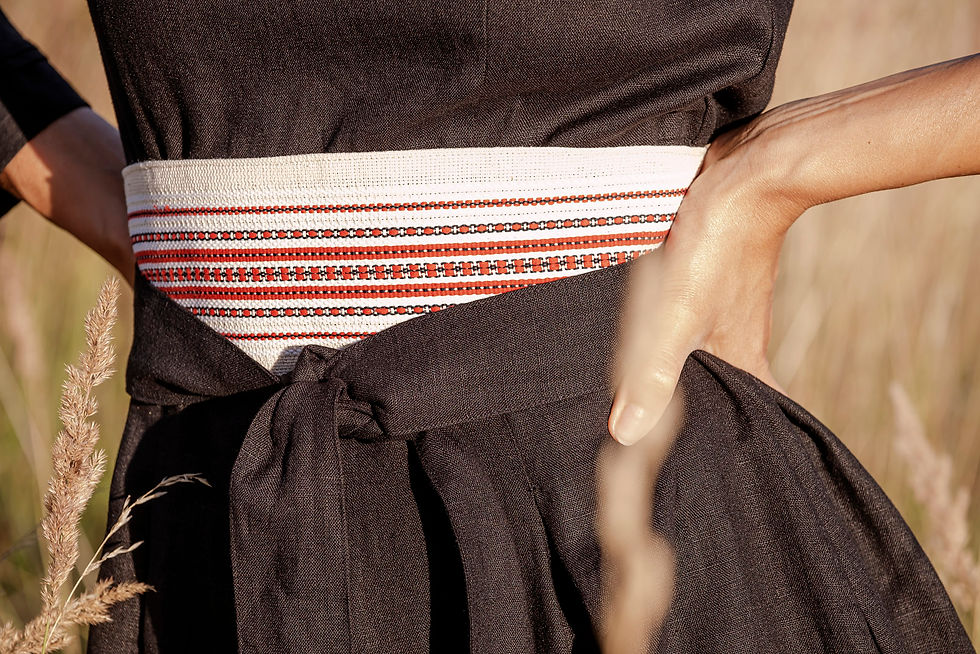
Each year, we establish more collaborations with artisans who hold the title of "Bearers of Folk Craft Traditions." I visit them gradually, learning about their techniques and production capabilities, as we search for items that can be sold in larger volumes at a price that compensates the artisan adequately. Through these new products, we introduce the craftsperson and their work, striving to engage as broad a public as possible. Our collection includes blueprint (modrotisk) products, headscarves, shawls, belts, and, as of this year, vests and ponchos from weavers, including traditional činovati (patterned weaving).
The reward for this approach—which truly energizes our future work—is the successful sales for satisfied artisans and the emails, messages, and photos from our customers. They share experiences of the reactions they receive from people around them, stories of unexpected conversations with strangers on the street about traditions, or compliments on how beautiful and feminine they look in these designs. Our customers return to us, gradually building mix-and-match wardrobes and, consequently, their own personal style. Today, we dress over 1,000 returning customers, providing both ready-to-wear and custom-made pieces. Thanks to the growing interest from the general public and media support, we are able to communicate our mission effectively, and we believe that together, we are on the best path toward sustainability.


Comments